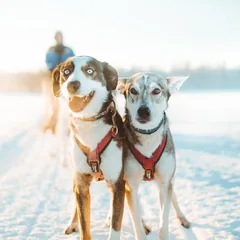
The dogs
The huskies of Rovaniemi: what they are and how they live
They are not the dogs on the calendar. The animals pulling sleds in Lapland are Alaskan huskies — leaner, faster, less symmetrical and considerably more interested in running than the blue-eyed Siberians most visitors are expecting. Here is what they are, why they scream before a run, and what to ask at the kennel.
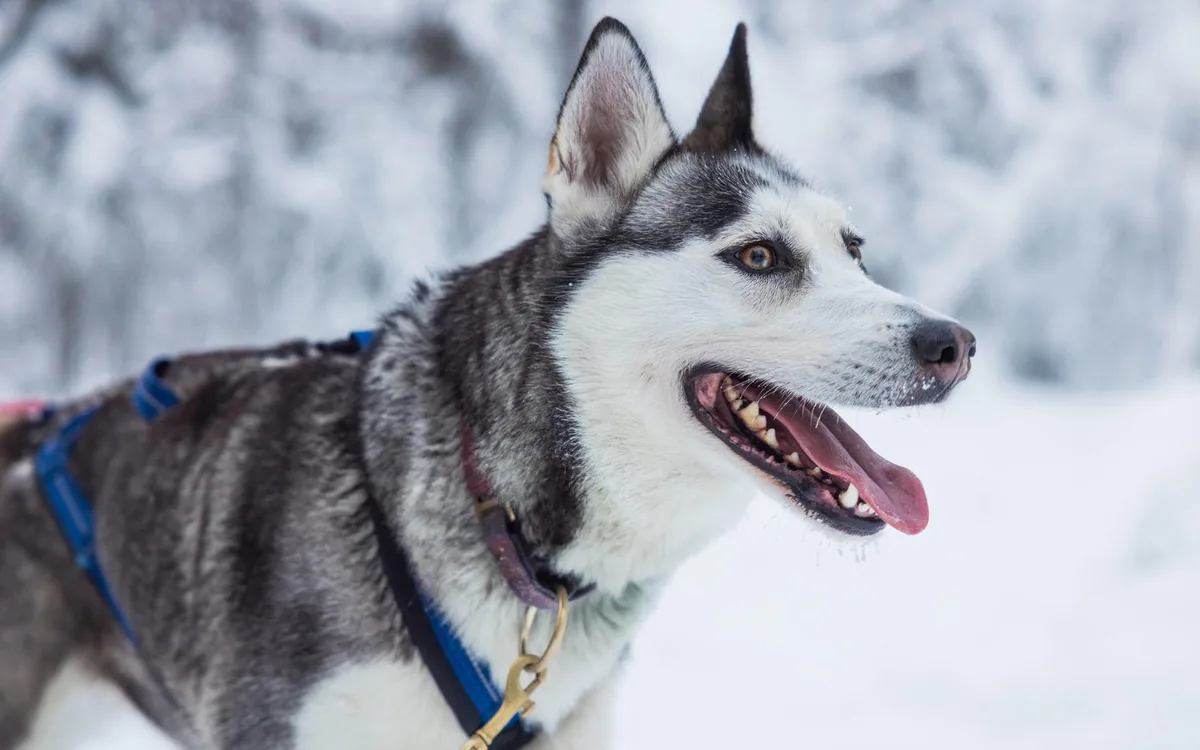
Quick answer
The sled dogs in Rovaniemi are almost always Alaskan huskies: not a breed but a working type, bred across generations for stamina, foot durability and appetite for running. A team is four to six dogs with two leaders at the front. They are extremely vocal before a run and completely silent once moving. Farm visits, where you meet them off harness, start at $86.
The dogs, at a glance
- Type
- Alaskan huskya working type, not a recognised breed
- Not
- Siberian huskythat is the show breed with the blue eyes
- Bred for
- Staminaand feet, appetite and temperament
- Team size
- 4–6two leaders at the front
- Speed
- 10–20 km/hover a working distance
- Noise before a run
- Considerableand it stops the moment the sled moves
- Kennel size
- Often 100+at the larger Rovaniemi farms
- Coat
- Doublethey are comfortable at minus thirty
- Meeting them
- At the kennelincluded on most safaris and all farm visits
- Farm visit from
- $86two hours, no sled
Alaskan or Siberian
What is the difference between an Alaskan and a Siberian husky?
Siberian is a breed. Alaskan is a working type, and it is the one pulling your sled.
One is a breed and the other is a job description.
The Siberian husky is a registered breed with a written standard: a set weight range, a particular coat, the distinctive markings, and often the pale blue eyes. It is the dog in every photograph of Lapland ever used to sell anything, and it does pull sleds — just not usually the ones you will be on.
The Alaskan husky is a working type rather than a breed. It has been selected for generations on performance alone: stamina over distance, tough feet, appetite, an even temperament in a team, and a coat that handles minus thirty. Because nothing about appearance is being selected for, they vary enormously — different colours, different sizes, different ear sets, and rarely the film-poster face.
The practical difference for a visitor is speed and endurance. Alaskans are faster over a working distance and they recover better, which is why nearly every commercial kennel in Rovaniemi runs them. If you were expecting a line of identical blue-eyed dogs, the reality is more mongrel and considerably more athletic.
The noise
Six things about the dogs that surprise visitors
All six come up in almost every review, and none appear in any listing.
- They are extremely loud before a run
A hundred dogs watching harnesses come out make a noise you can hear from the car park. It is enthusiasm rather than distress, and it is genuinely startling the first time.
- And then completely silent
The instant the sled moves it stops. Runners on snow, dogs breathing, nothing else. This is the moment everyone describes afterwards.
- They are friendly, not aloof
Working sled dogs are handled constantly and by many people. They are interested in you mostly as a source of attention.
- The leaders are chosen, not senior
The two at the front take direction and set the line. It is a temperament and an aptitude rather than a rank, and mushers will talk about individual leaders at length.
- They are comfortable in cold you are not
Double coats, and they sleep outside by choice at temperatures that would end your day. In summer the same dogs are visibly less energetic.
- They do not stop when you fall off
Which is the entire reason for the one rule. It is not a discipline problem; it is what they are for.
The place to ask about how the dogs are kept is the kennel, and every farm visit includes time there.
Farm and kennel visits→Every trip, current fare
Every tour, and how much time you get with the dogs
Twelve tours, cheapest first. The farm visits are the ones with no distance in the last column, and they are where you spend longest with the animals.
| Tour | Length | Price | On the sled | Cost per hour | Rating |
|---|---|---|---|---|---|
| Santa Claus Village Husky RideThirty minutes on the Arctic Circle | 30 min | $69 | ~1 km, you ride | $138.00 | 4.7 · 1,584 |
| Husky Farm VisitA kennel visit with no sled at all | 2 h | $86 | None — kennel only | $43.00 | 4.8 · 11 |
| Husky Farm Visit with a Sledge RideA farm visit with a short ride attached | 2 h | $114 | Short, you ride | $57.00 | 4.2 · 243 |
| Husky Farm and Reindeer ExperienceHuskies and reindeer in one afternoon | 3.5 h | $178 | Short, you ride | $50.86 | 4.3 · 553 |
| Reindeer, Huskies & Santa Claus VillageThe fullest single day on this page | 6 h | $205 | Short, you ride | $34.17 | 4.6 · 2,415 |
| Daytime Husky SafariNinety minutes, out and back | 1.5 h | $207 | You ride | $138.00 | 4.6 · 1,036 |
| Husky, Reindeer & SnowmobileHuskies, reindeer and a snowmobile | 6 h | $216 | Short, you ride | $36.00 | 4.6 · 1,289 |
| Self-Drive Husky Sled, 4–5 kmThe cheapest way to drive your own team | 3 h | $224 | 4–5 km, you drive | $74.67 | 4.6 · 284 |
| Apukka Husky Adventure, 6 km self-drivenSix kilometres self-driven, most reviewed | 3.5 h | $239 | 6 km, you drive | $68.29 | 4.6 · 1,568 |
| Husky Safari with Transfers & BBQFour hours with a fire stop, rated 4.9 | 4 h | $239 | You drive | $59.75 | 4.9 · 220 |
| Insider 10 km Husky Sled RideTen kilometres, deep into the forest | 4 h | $250 | 10 km | $62.50 | 4.6 · 172 |
| Husky Safari on a Snowy Trail, 10 kmTen kilometres on a forest trail | 3.5 h | $261 | 10 km | $74.57 | 4.7 · 496 |
Common questions
The huskies, answered
What kind of dogs pull sleds in Rovaniemi?
Alaskan huskies, almost always. They are a working type bred for stamina and speed rather than appearance, and they are leaner and less uniform than the Siberian huskies most people picture.
Why are the huskies so loud before a run?
Because they have worked out what is about to happen and they want to go. It is excitement, not distress, and it stops completely the moment the sled starts moving.
How many dogs pull one sled?
Four to six, depending on the weight of the sled and the distance. The two at the front are the leaders and they take the direction.
Are the huskies happy?
The dogs are bred and kept to run, and it is visible: the noise before a run is the clearest evidence anybody could ask for. The proper way to judge a specific farm is to visit the kennel and ask directly how the teams are rotated, rested and retired — every farm worth booking answers that.
Can you meet the huskies after the safari?
On most safaris, yes: the tour ends at the kennel with the dogs off harness. A dedicated farm visit gives you far longer, and starts at $86.
Do the huskies mind the cold?
No. They have double coats and are comfortable sleeping outside at temperatures that would end a human day. It is summer, not winter, that slows them down.
Go deeper
More on husky tours in Rovaniemi
Husky safaris in Rovaniemi
Every safari compared, by distance rather than by hours.
The activityDog sledding in Lapland
How it works, what the season is, and what it costs.
You driveDriving your own team
The runners, the brake and the one rule that matters.
FarmsHusky farms and kennel visits
The version with no sled at all, and who it suits.
The villageSanta Claus Village
Thirty minutes on the Arctic Circle, eight kilometres north.
The verdictWhich one is best
One recommendation for each kind of visitor.